
Why is it so important to control temperature in an industrial process?
Why is it so important to control temperature in an industrial process?
Industrial temperature control is a key element in ensuring the quality, safety and efficiency of production processes. In many facilities, maintaining an appropriate temperature is essential for materials, fluids and equipment to operate under the intended conditions.
A temperature that is too high or too low can alter the properties of a product, increase energy consumption or cause production incidents. For this reason, having reliable thermal control systems adapted to each application is fundamental to ensuring the continuity of industrial processes.
Why is it essential to control temperature in industry?
Temperature directly influences the behaviour of materials and the performance of equipment. Controlling it correctly makes it possible to maintain the necessary conditions at each stage of the process and provides important benefits.
- Process quality and stability: thermal variations can modify the characteristics of products or affect the results of certain operations. Maintaining a stable temperature contributes to achieving more uniform production.
- Facility safety: in processes involving fuels, chemical products or fluids at high temperatures, preventing overheating is essential to reduce risks and protect equipment.
- Energy efficiency: adjusting the heat input to the actual needs of the process helps avoid unnecessary consumption and use energy more efficiently.
- Equipment service life: operating within the specified temperature ranges helps prevent premature deterioration of components and reduce incidents associated with unsuitable operating conditions.
Thus, thermal control not only makes it possible to reach a specific temperature, but also to maintain it safely and efficiently.
 How is precise thermal control achieved?
To control the temperature of an industrial process, it is necessary to combine a measurement system with equipment capable of regulating the heat input.
Sensors measure the temperature of the fluid or the point in the installation that needs to be controlled. Based on this information, the regulation system adjusts the operation of the heating equipment to maintain the established conditions.
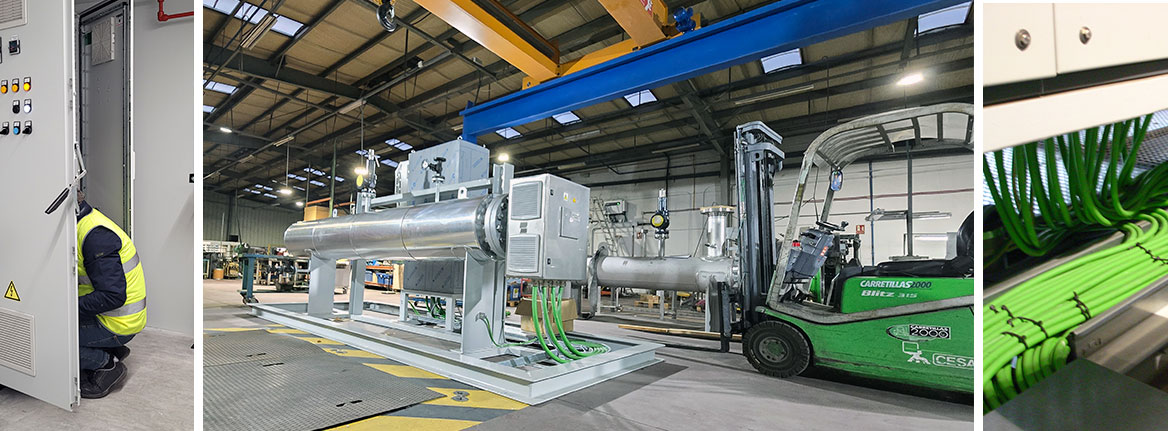
Within this system, control cabinets play an important role, as they allow the necessary regulation, switching and protection components to be integrated.
However, there is no single solution suitable for all applications. The characteristics of the fluid, the flow rate, the required power and the operating conditions determine which system is the most appropriate.
For this reason, the design and sizing of the equipment are just as important as the control system itself.
Industrial electric heating solutions from IES SOLER
Industrial electric heating makes it possible to heat fluids and maintain process temperatures using equipment designed to meet specific needs.
At IES SOLER, we develop solutions for different industrial applications, including electric immersion heaters and electric heat exchangers.
Immersion heaters allow heat to be transferred directly to the fluid contained in a tank or vessel. Electric heat exchangers, on the other hand, are used in installations where circulating fluids need to be heated, such as water, oils, air or certain gases.
This equipment can incorporate measuring instruments, safety components and control systems adapted to the requirements of each installation.
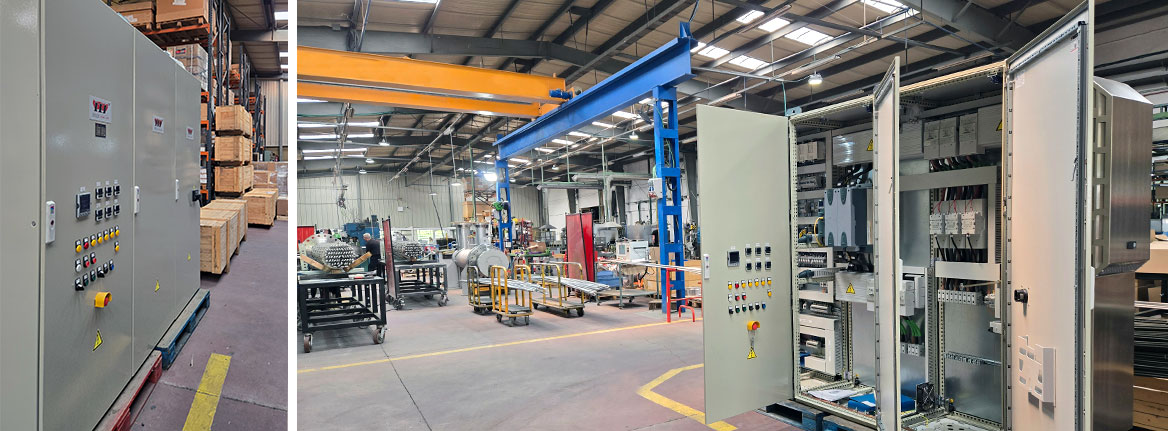
The applications are diverse. In the chemical industry, thermal control is involved in heating products and maintaining their properties. In the energy and Oil&Gas sector, it is necessary to condition fuels and other fluids that must operate at specific temperatures.
The key is to select a solution that takes into account the actual conditions of the process. For this reason, at IES SOLER, we focus on custom engineering solutions that allow the design, materials and control systems to be adapted to the needs of each project.
Real case: thermal control at a power plant in Libya
An example of the application of these solutions is the project developed for METKA at the Tobruk power plant in Libya, a simple-cycle installation with a total capacity of 740 MW.
In this project, IES SOLER designed and manufactured the equipment required to heat the liquid fuel intended to supply four General Electric GT13E2 turbine

The solution included four 320 kW ATEX electric heat exchangers and two 20-foot containers, each equipped with two control cabinets.
This project illustrates how an industrial thermal solution must meet the specific requirements of the installation, integrating heating equipment and control systems into a single assembly.
The importance of a solution adapted to each process
Controlling temperature correctly is essential to achieving safe, efficient and stable industrial processes. However, to obtain a good result, it is necessary to select equipment suited to the characteristics of each application.
With more than 80 years of experience, IES SOLER offers industrial electric heating solutions adapted to the needs of each project, combining technical knowledge, engineering and specialised manufacturing.

